.svg "Paula")

This page is the free replay of our August 5, 2026 webinar for Canadian wealth and asset management firms: how to get your firm cited by AI assistants like ChatGPT, Gemini and Perplexity. Below the video, the full teaching is written out as a guide, with every claim linked to its source. Paula Inc. is a Toronto branding and marketing agency for financial services. The practice is called answer engine optimization, or AEO, also known as generative engine optimization, or GEO.
The baseline: how an AI answer gets built
Search used to hand you a page of links. Your job was to rank on it.
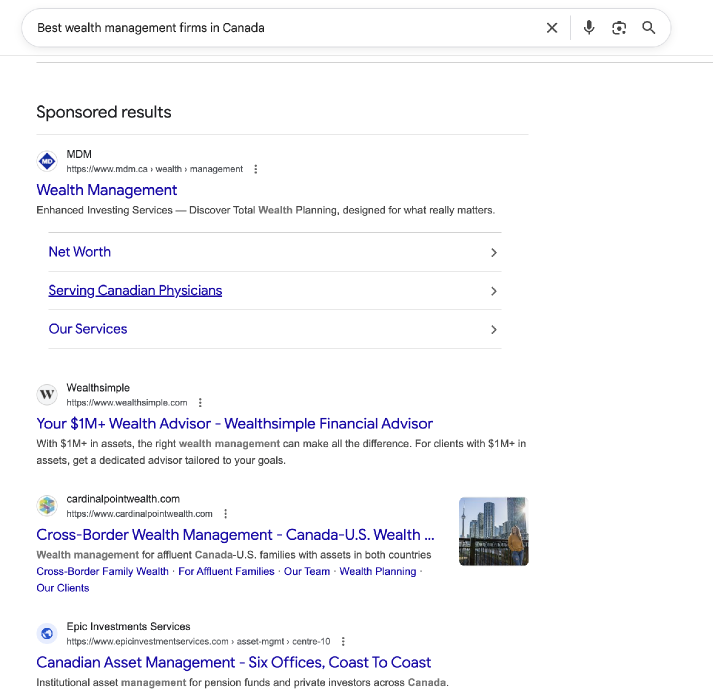
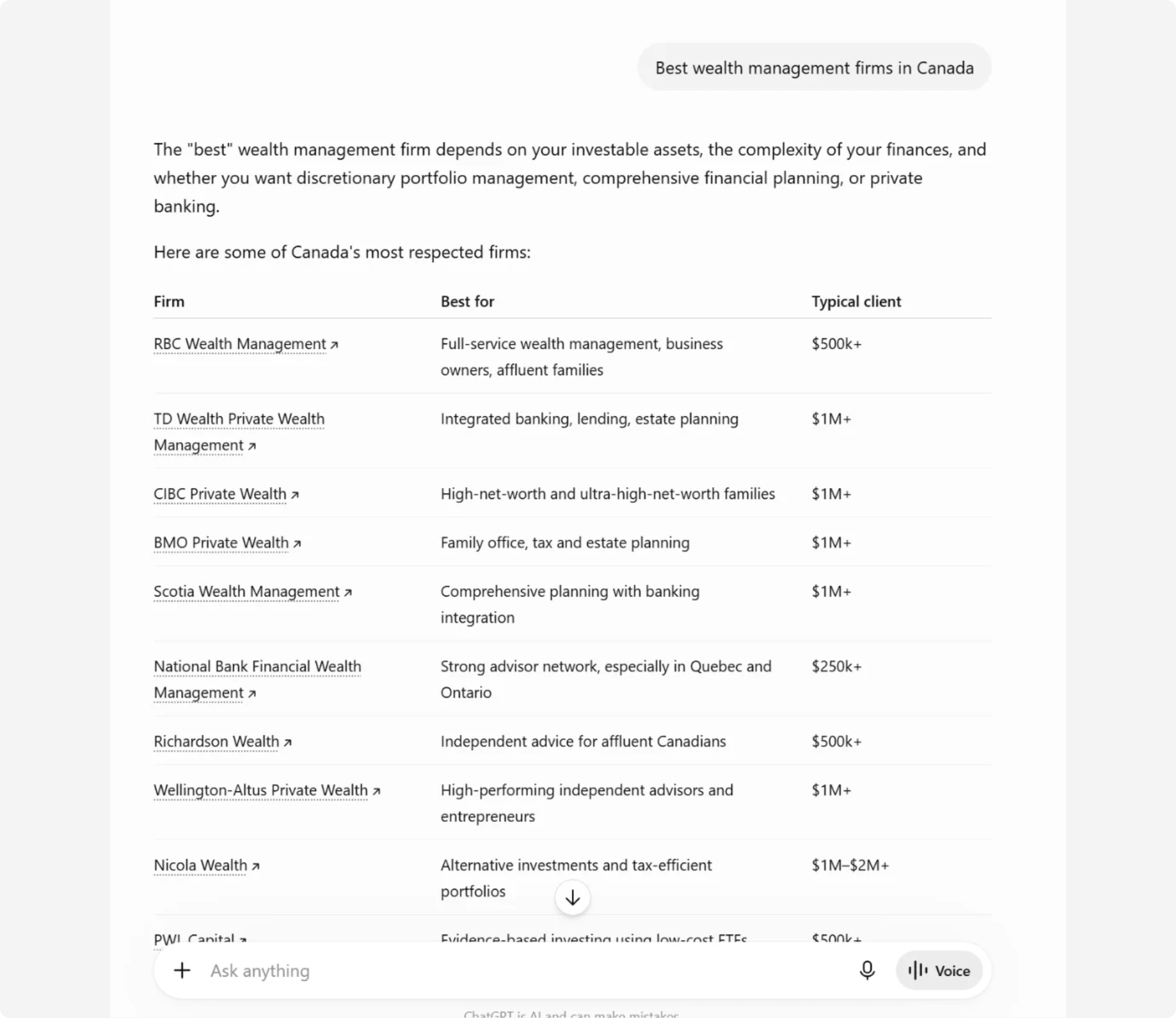
An AI assistant answers the question instead.
Analysis, reasoning, sometimes a recommendation. When your prospects let the machine do the thinking, the job becomes influencing the answer, not just the ranking.
A referral used to be enough for a meeting. Now a referral triggers a check, and the check runs through an AI assistant.
The research. Wealthtender, a US financial-advisor directory and review platform, ran the survey. It's US data and stated intent rather than measured behaviour, so treat it as directional for Canada. Wealthtender survey
The front door to AI answers is still ordinary search.
OpenAI names Bing as ChatGPT search's provider. Google says the SEO fundamentals still decide. If search can't find you, the machine falls back on stale memory, or on what other people say about you.
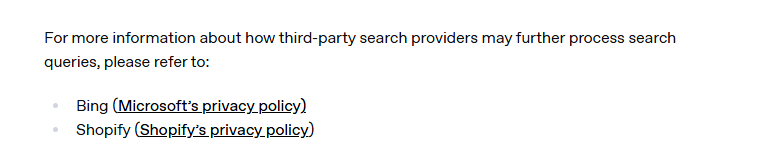
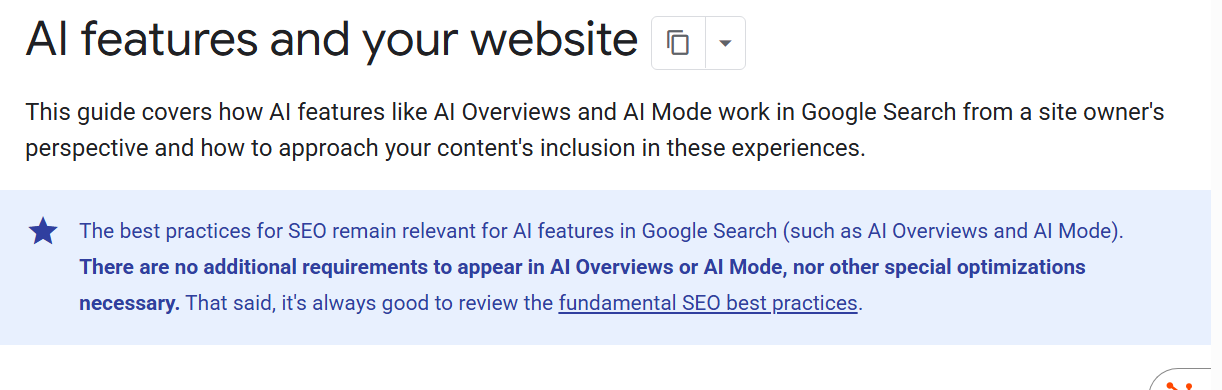
The research. Both companies say it in their own documentation. OpenAI on ChatGPT search · Google on AI features
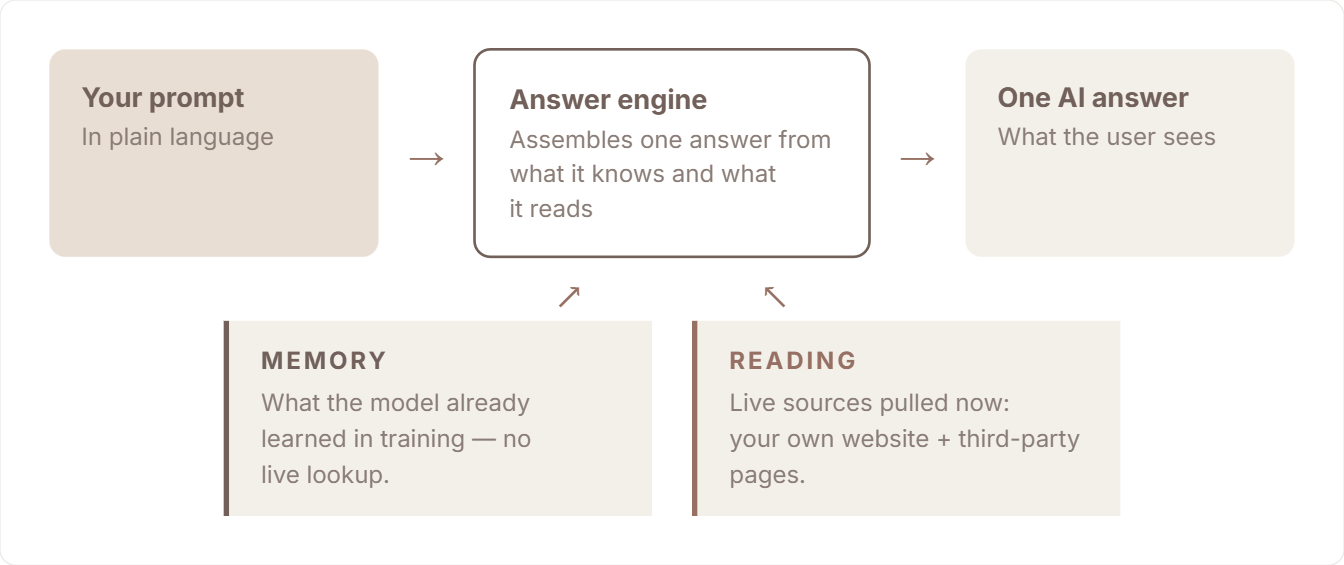
Every answer draws on two inputs: memory and reading. Your website can only influence the reading side.
A firm can show up three ways: source, mention, recommendation. Getting one doesn't get you the others.
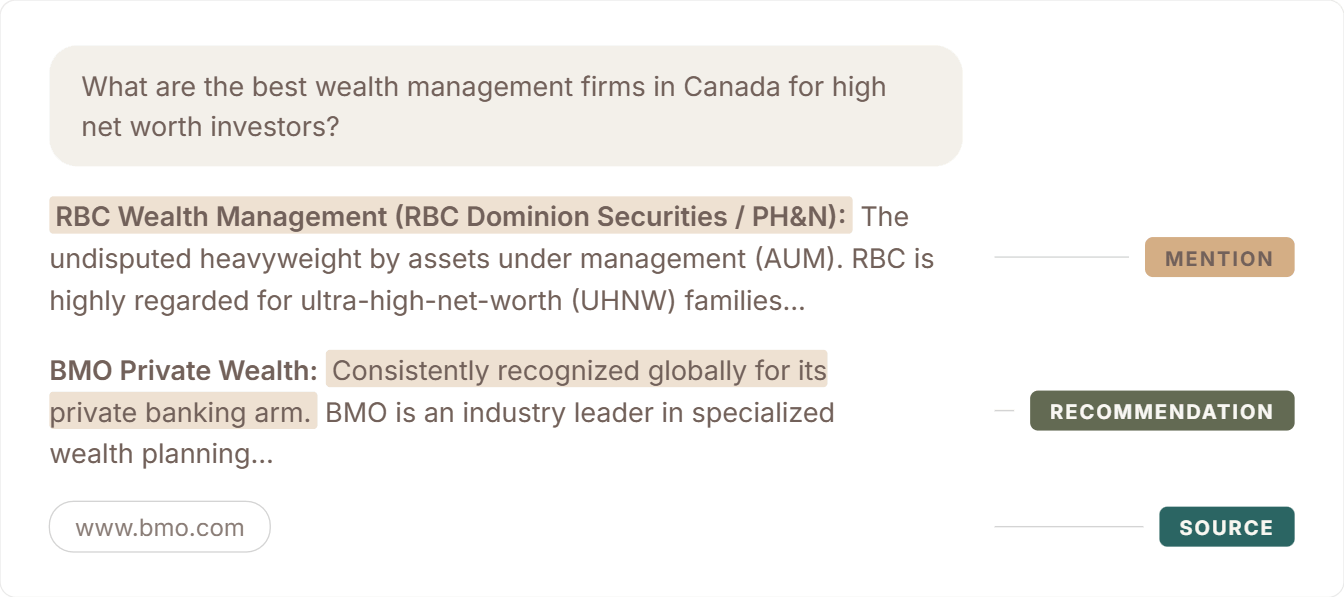
Ranking gets you into the pool. It does not get you into the answer.
Two selections decide every answer. Classic SEO decides who is in the pool of sources; a second pass, inside the machine, decides which of that pool actually shapes the answer.
In June 2026 we ran our own measurement: we asked ChatGPT, Perplexity, Google AI Overviews and Copilot the questions Canadian wealth prospects actually ask, every day for fifteen days — 893 answers in total. One boutique cross-border firm shows what the gap looks like. The engines cited its pages as a source in 77 of those answers. Only 15 answers actually said the firm's name. The machines read its content constantly and rarely name it. This happens to good firms; it is the second selection, made visible.
The research. The AEO for Wealth Management study (June 2026) is our own: 893 AI answers to Canadian wealth questions. Independent support comes from CC-GSEO-Bench, a 2025 benchmark led by a Zhejiang University team: across 5,353 query-and-document pairs, simply being retrieved had almost no relationship with influencing the answer. One offline simulation, one model, so a supporting data point rather than proof. CC-GSEO-Bench
The tactics, ranked by impact
These are the plays we believe make the most difference, plus a few that don't but that the industry sells hard. We ranked them all against the evidence, in three buckets.
Overhyped
First, the three tactics the industry talks about most. They sound machine-friendly. The engines don't lean on them much.
Does llms.txt actually do anything?
llms.txt is a proposed file that sits at yoursite.com/llms.txt: a menu of your pages, written for AI crawlers instead of people. The pitch is that AI assistants read the menu and know where to go. The measurement says nobody is reading the menu.
The research. Ahrefs examined 137,210 domains in May 2026. About 38,000 had an llms.txt file, and 97% of those files were never requested once, all month. The few requests that arrived came mostly from SEO audit tools checking whether the file exists. Google's John Mueller said it plainly in June 2025: "FWIW no AI system currently uses llms.txt." No AI company has said it uses the file. Ahrefs study · Mueller on Bluesky
Recommendation. Skip it. If you already have the file, leave it; it costs nothing sitting there. Put the effort into the four checks below, which are measured and free.
Does schema markup get you cited by AI?
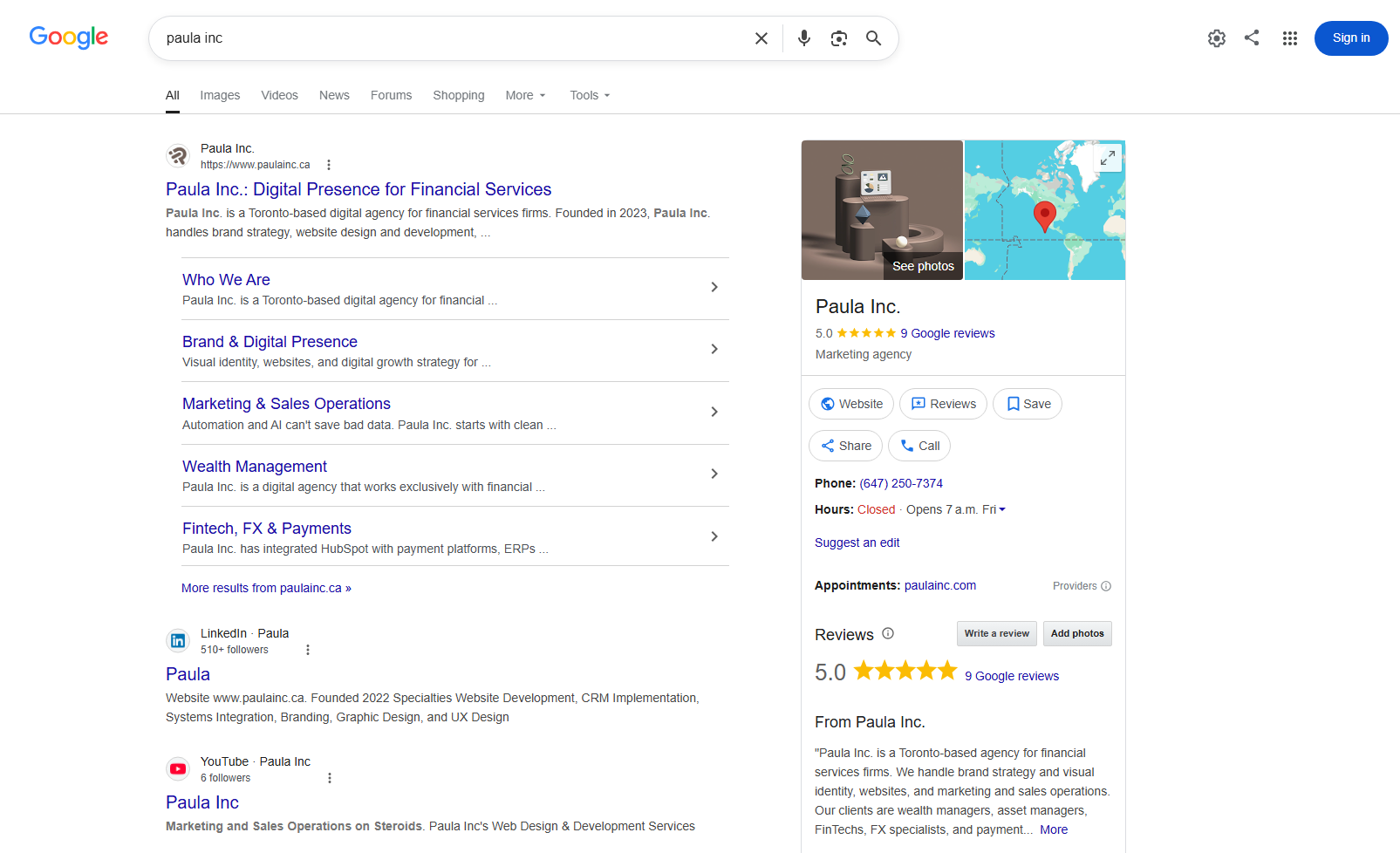
Schema is invisible code that labels your page for machines: this is our company name, this is a FAQ, this is the author. The AI assistants don't read the hidden code. They read your visible text, same as you. Where schema still earns its keep is the classic Google results page: star ratings, dropdowns, the info panel about your firm.
{
  "@context": "https://schema.org",
  "@type": "FinancialService",
  "name": "[firm name]",
  "url": "https://[yourdomain].ca/",
  "areaServed": { "@type": "Country", "name": "Canada" },
  "parentOrganization": { "@type": "Organization", "name": "[parent, if any]" },
  "sameAs": [ "[LinkedIn or other verified profile]" ]
}
This is what schema still buys you: the enhanced listing on a classic Google results page. Star ratings, dropdowns, the info panel about your firm. That's schema working, and it's the reason to keep it.
The research. The largest controlled test we have comes from Ahrefs. They tracked 1,885 pages that added schema between August 2025 and March 2026 against about 4,000 similar pages that didn't, and found no measurable lift in AI citations. Their own conclusion: they can't tell whether it did a tiny bit of good or nothing at all. Ahrefs schema study
Recommendation. Keep the schema you have; it does real work in classic Google, and classic Google fills the pool. Just don't fund a schema project as an AI play.
Should you rewrite your pages as FAQs?
A FAQ that answers what your prospects actually ask is good for your visitors. Keep it. The project to skip is rewriting everything into question-and-answer format: the machine rewards pages that contain answers, not pages shaped like answers. What measures better is clear definitions backed by real evidence.
A fee-only advisor is paid directly by the client and takes no commission from product providers.
Only 9% of Canadian small business owners have a formal succession plan (CFIB, 2022).
The research. In 2023 Google restricted FAQ rich results to government and health sites, and in May 2026 it retired the feature entirely (Google's documentation). An April 2026 preprint scored 21,143 citations and found pages written in question-and-answer form scored about 5.7% lower than everything else, with definition-dense pages highest. The authors describe that work as descriptive only, and the AEO for Wealth Management study (June 2026) graded it suggestive rather than settled. FAQ preprint
Recommendation. Keep your FAQ for people. Spend the rewrite budget on definitions and evidence instead.
Must do: four checks
Everything from here is what we actually recommend, in priority order. These four are quick, and if they fail, nothing else counts.
Is your robots.txt letting the AI bots in?
robots.txt is a public file at yoursite.com/robots.txt. It's your doorman: it tells each visiting bot, by name, "come in" or "stay out." If it blocks the AI crawlers, you can forget being cited. The bots that matter for citations: OAI-SearchBot (ChatGPT answers), Claude-SearchBot (Claude answers), PerplexityBot (Perplexity answers), Googlebot (AI Overviews).
The file is public, so you can read anyone's. The New York Times blocks those bots by name. Your file might block them too, without anyone at your firm ever having decided it. An open file doesn't need to name a single bot; most sites are open by default unless someone configured them otherwise.
User-agent: GPTBot
Disallow: /


User-agent: OAI-SearchBot
Disallow: /


User-agent: Claude-SearchBot
Disallow: /


User-agent: PerplexityBot
Disallow: /
User-agent: *
Disallow: /search/
Disallow: /data/
Disallow: /login/
Disallow: /admin/
Disallow: /uploads/
Sitemap: https://www.ceifx.com/sitemap.xml
The research. Read the two files yourself: nytimes.com/robots.txt names and blocks the AI bots; ceifx.com/robots.txt is what an open door looks like.
Recommendation. Open yoursite.com/robots.txt. Search the page for OAI-SearchBot, Claude-SearchBot, PerplexityBot and Googlebot. If any of them appears above a line reading Disallow: /, you are blocked from that engine's answers.
Is your firewall turning AI crawlers away?
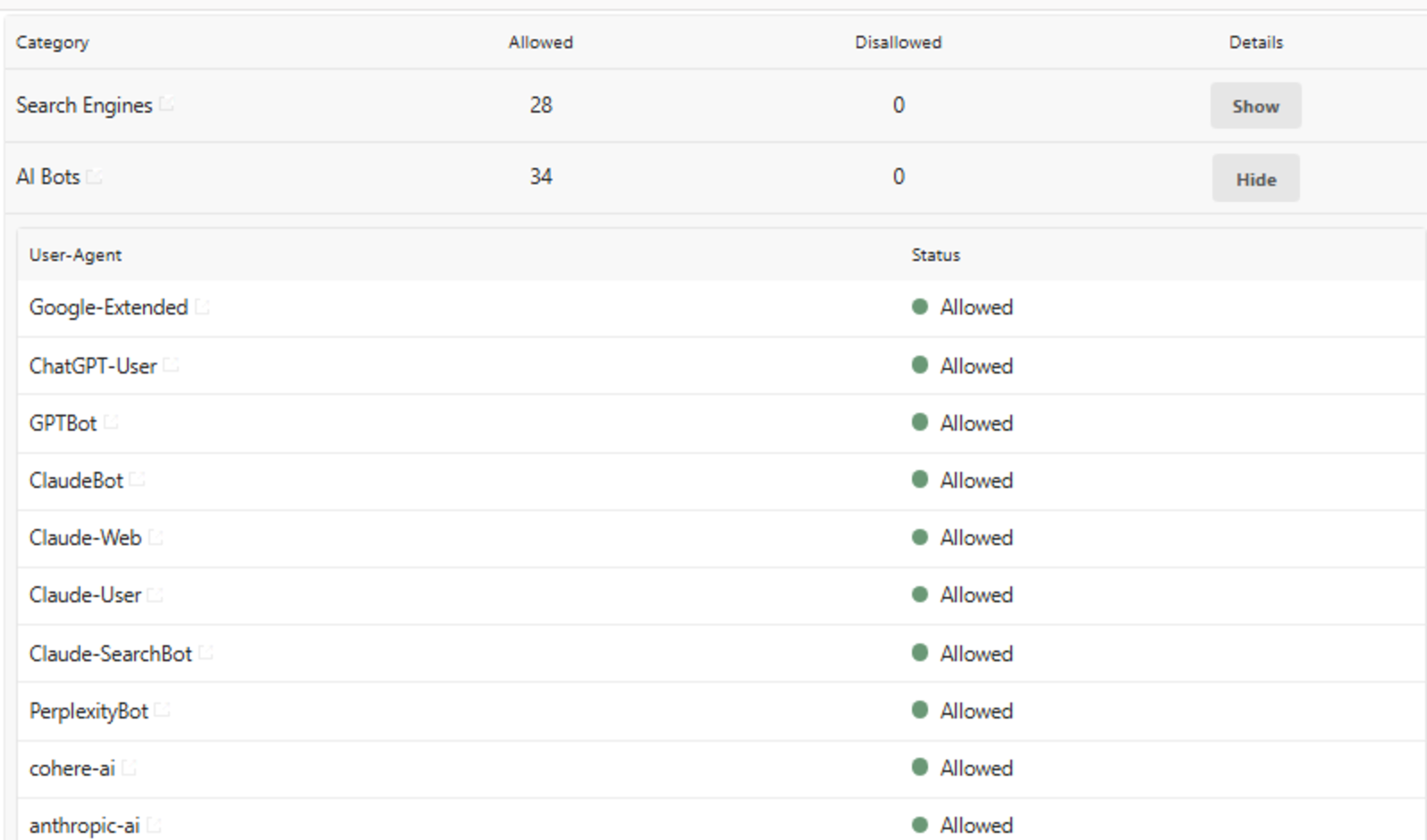
Your site probably sits behind a security service: Cloudflare, Akamai, whatever your host set up. It can turn AI crawlers away without anyone at your firm deciding it. One free check, crawlercheck.com, reads every door at once: robots.txt, meta robots, headers, firewall. When we ran our own domain, all 34 AI bots it checks were allowed through.
The research. Blocked access tracks with invisibility. A peer-reviewed study from the New Jersey Institute of Technology (SIGIR 2026) ran 14,212 questions and found 21 major publishers that Google Search and AI Overviews retrieved regularly but Gemini never cited once. Every one of the 21 blocks Google's AI crawler; the New York Times is one of them. It's a correlation, and it's specific to Gemini, but the gate is real. NJIT study
Recommendation. Run your domain through crawlercheck.com. It takes about forty seconds.
Can the machines read what you wrote?
What you see and what a bot reads can be two different documents. Modern sites build pages with small programs that run in your browser, and most AI bots don't run those programs; they read only the raw text your server sends. The classic failure is the click-to-open FAQ: every human sees answers, every bot sees questions with nothing underneath.
<h3>How are your fees structured?</h3>
[answer not in the raw page]


<h3>What is your investment minimum?</h3>


<h3>Who do you work with?</h3>
The research. Vercel, the cloud platform behind a large share of modern websites, measured billions of bot requests in late 2024. The bots from OpenAI, Anthropic and Perplexity never ran the JavaScript that builds modern pages; only Google's bot did. Crawler behaviour changes, so call it the last good measurement rather than today's certainty. Vercel study
Recommendation. The 30-second check: open your most important page, right-click, View Page Source, and search for a sentence you know is on the page. Can't find it? Neither can most AI engines. Take it to your web team.
Do you still need classic SEO for AI visibility?
Yes. Search decides whether the machine can consider you at all. Five things matter most now:
The research. Ahrefs looked at 863,000 keyword results pages and 4 million URLs cited in AI Overviews in March 2026: 37.9% of cited pages ranked in Google's top 10, 31.2% ranked in positions 11 to 100, and 31.0% didn't rank in the top 100 at all. A year earlier, roughly three quarters came from the top 10, so reach now beats a single trophy position (Ahrefs on AI Overview citations). On speed: iPullRank, using data from Profound across 700,000 pages, found pages that timed out on more than three quarters of crawler fetches got roughly 18 times fewer citations, and many got none. Profound's dataset is proprietary and they sell against the problem they measure (iPullRank on page speed).
Recommendation. Hand this list to whoever runs your SEO.
Rather have these four checks run for you? We're doing free AEO audits for webinar viewers. Details at the end of this page.
Jump to the audit →Should do, part one: content built to be lifted
The doors are open. Now, does the machine find anything it can carry away?
Where on the page should the answer sit?
Engines don't lift pages. They lift passages: a few sentences that answer a question on their own. Where those sentences sit is measured, and the top of the page wins.
Here is the same firm, the same facts, twice. The first buries who they are at the bottom. The second says it in the first sentence. Neither is badly written; one is findable. (Sample copy, not a real firm.)
For over a generation, our team has partnered with discerning families to build lasting financial confidence. We believe wealth is deeply personal, and our approach reflects that: thoughtful, disciplined, and always aligned with what matters most to you and the people you love. Rosedale Private Counsel is an independent, fee-only wealth manager in Toronto advising families with $1M+ in investable assets.
Rosedale Private Counsel is an independent, fee-only wealth manager in Toronto. Since 2004 we have advised incorporated professionals and families with $1M+ in investable assets, charging a flat annual fee with no commissions.
The research. Kevin Indig, who previously led SEO and growth at Shopify, G2 and Atlassian, isolated 18,012 verified citations out of 1.2 million AI answers in February 2026 and located where the cited text sat: 44.2% came from the first 30% of the page, and content in the last third was cited about 1.8 times less often. Indig's citation study
Recommendation. On every page that matters, put the facts in the first sentences and earn the right to elaborate after.
What kind of sentence gets quoted?
The same principle, one level down: the sentence itself. Watch one sentence improve in three steps.
The first can't be quoted. The third travels on its own: a number, a source, a year.
The research. In the largest controlled test of editing tactics, a Princeton-led team (peer-reviewed at KDD 2024) tried nine ways of editing a page to get it cited more, across 10,000 queries. The three that worked were adding statistics, adding quotations, and citing sources, with improvements of 30 to 40%. Keyword stuffing did nothing (the GEO paper). The 9% figure is from CFIB's 2022 survey of 2,479 Canadian business owners (CFIB succession study).
Recommendation. Find the vague sentences on your most important page and replace each with a named, dated, linked fact.
What should the top of your homepage say?
The single easiest move on this list: 50 to 80 words near the top of your homepage, in plain visible text, saying what your firm is, where it's based, and who it serves. The "After" paragraph above is the shape. The paragraph under the video on this page is our own attempt at the same thing.

Recommendation. Open your homepage and check the first screen: is there a plain-text paragraph saying what your firm is, where it's based, and who it serves? If not, write one — 50 to 80 words, near the top.
How much of your page does the machine actually read?
The machine has a reading budget. Per question, Google's AI reads about 2,000 words across all its sources, and takes about 377 words from any one page. Pages under 1,000 words had 61% of their content used; pages over 3,000 words, 13%. Longer pages don't give up more: it plateaus around 540 words, however long you write.
The research. Dan Petrovic of DEJAN watched what Google hands its Gemini model when it grounds an answer: 7,060 queries, 883,262 snippets, December 2025. This is Google's pipeline specifically, not ChatGPT or Perplexity. Petrovic's grounding study
Recommendation. Prefer short, focused pages: one question per page, answered high up.
Why own a niche?
Owning a niche means being the firm that one specific question belongs to. Not a category like wealth management or retirement planning, but a question narrow enough to have an obvious best answer: "planning for an incorporated physician," say. You pick the question your firm was built to answer, and you publish the best answer to it on your own domain.
It works because of who the engines quote on questions like that. On most questions, the engines lean on pages about firms: media rankings, directories, forums. On specialist questions, that flips — they go straight to pages published by the firms themselves. 83.7% of citations on specialist questions in the AEO for Wealth Management study (June 2026) pointed at firms' own sites: 1,292 of 1,543. No publication stands between your page and the answer. This is the one arena where your own page decides the answer, and the strongest version of that page answers the question with numbers only you have.
The research. The AEO for Wealth Management study is our own measurement of AI answers to Canadian wealth questions.
Recommendation. Decide the one question your firm should own, and publish the best answer to it on your own site.
What does owning a niche look like?
"Best wealth manager for an incorporated physician." Out of 60 answers to that question in the AEO for Wealth Management study, a physician-focused specialist firm was named in 45. The runner-up, a major bank, appeared in 31: outspent the specialist on every other front, still second here. The only other firm that keeps surfacing on the question is also a specialist, and also small. That's not luck. It's years of being about one thing.
The research. The AEO for Wealth Management study; the 60 answers are 15 days of questions across four engines.
Does AI prefer fresh content?
Moderately, yes. Pages cited in AI answers average 2.9 years old; pages in ordinary Google results, 3.9 years. The preference is real but it is not a blanket rule: the gap comes from ChatGPT, Copilot, Gemini and Perplexity, while Google AI Overviews sits at 3.9 years, the same as organic. One do-not-do: changing the date without changing the page. No engine has published evidence that this is penalised, and none has published evidence that it works. And a false "updated" stamp on financial guidance is a compliance conversation you don't want.
The research. Ahrefs measured 16.975 million cited URLs in July 2025 (Ahrefs on freshness). On faked dates, no engine has published evidence either way. Google's documentation on publication dates is part of the basis for this: a date is supposed to describe when the page actually changed, and Google works the real date out from several signals rather than taking the stamp at its word (Google on publication dates).
Recommendation. Update pages when something real changed, and date them honestly.
Should do, part two: beyond your own website
Everything so far happens on pages you control. On shortlist questions, "who are the best firms," other people's pages take over. The last block of work moves off your website.
Do backlinks still matter for AI visibility?
They keep their old job: backlinks feed rankings, and rankings feed the pool. Mentions do the new job: they shape who the answer talks about. A backlink is another site linking to yours. A mention is your name in their text, link or no link.
The research. Ahrefs measured 75,000 brands against their visibility in Google AI Overviews in May 2025. Brand mentions across the web correlated at 0.664, a moderate relationship. Referring domains sat at 0.295 and backlinks at 0.218, weak ones. Correlation only, the authors say so themselves, and Ahrefs sells the tool that measures mentions. Ahrefs on mentions vs backlinks
Recommendation. When you invest in visibility, buy your name in the text, not just the link.
Which websites do the engines cite most?
For Canadian wealth questions, we can name them. These are the ten third-party domains the engines leaned on most in the AEO for Wealth Management study (June 2026), with the door each one has.
| # | DOMAIN | WHAT IT IS | CITATIONS | SHARE | DOOR |
|---|---|---|---|---|---|
| 1 | reddit.com | Community forum | 361 | 4.2% | — |
| 2 | wealthprofessional.ca | Trade press | 336 | 3.9% | ENTER |
| 3 | milliondollarjourney.com | Personal-finance blog | 178 | 2.1% | PITCH |
| 4 | springfinancial.ca | Financing provider | 160 | 1.9% | — |
| 5 | youtube.com | Video | 130 | 1.5% | PITCH |
| 6 | smartasset.com | Advisor aggregator | 106 | 1.2% | PITCH |
| 7 | canada.ca | Government | 106 | 1.2% | — |
| 8 | dakota.com | Database | 101 | 1.2% | CLAIM |
| 9 | wsj.com | News | 70 | 0.8% | — |
| 10 | altss.com | Allocator database | 62 | 0.7% | CLAIM |
Together, these ten are 18.6% of every source the engines cited. ENTER: awards and rankings with entry processes. PITCH: roundups and media with authors who take pitches. CLAIM: databases with profiles you can claim. A dash means no door; you can pitch a forum.
Single pages carry surprising weight. One Spring Financial post, "Best wealth management firms in Canada," was cited in 123 separate answers. One Wealth Professional 5-Star listing, 79.
The research. The AEO for Wealth Management study (June 2026): 8,645 citations across 893 answers.
Recommendation. Treat this as a target list: be in them, be accurate in them, be current in them.
The free AEO audit includes how often the engines cite you today. Details at the end of this page.
Jump to the audit →Should your firm publish a comparison page?
A comparison page is one page that puts two options side by side and says plainly who each one suits. Bank or independent. Fee-only or commission. Advisor or robo. You write it about your own category, and you include the side you are not on.
The engines reach for these pages because prospects ask comparison questions. When one exists, it gets used, even when a firm wrote it about itself: about one in three of the cited comparison pages in the AEO for Wealth Management study were firm-published. The bar is fair to the other side, specific, sourced. In most categories, you would be the only firm who bothered.
The research. The AEO for Wealth Management study; the comparison-page split is directional, classified by page title.
Recommendation. Write the fair comparison your category is missing.
Can an ordinary firm actually win this way?
Three ordinary Canadian firms, one comparison page each, and the engines keep coming back to them. CC & Associates, an Ontario planning firm — its bank-vs-independent comparison was cited 36 times in the study. AT Finance — its self-published "best wealth management companies" roundup, cited 46 times. Wellington-Altus — one advisory team's big-banks-vs-private-wealth comparison, cited 38 times. For scale: the AEO for Wealth Management study (June 2026) cited 2,485 different pages, and only fifteen of them were cited more than 35 times. No single page on any Big-6 bank's website was above 31. None of these firms outspent a bank. They wrote the page nobody else in their category had written.
The research. The AEO for Wealth Management study.
Your to-do list
The order is the strategy: open the doors first, then content worth lifting, then other people's pages. Copy it into your project tracker.
A free AEO audit of your website, for watching the session.
How often the engines cite you today, whether you're letting the bots in, and your fastest fixes, prepared by our team for your domain.

A decade inside financial services before starting Paula in 2023.

More than ten years across web development, technical SEO and digital operations.
Questions about your own site: info@paulainc.ca · Follow Paula Inc. on LinkedIn