.svg "Paula")

This is the free replay of our September 8, 2026 webinar for wealth management firms, presented by Kaushik Kumar of Kaushik Kumar Digital. It covers whether Google Ads make sense for your firm, what needs to be in place first, what to budget, and how to get a first campaign live in 30 days. Below the video, each slide is laid out with a short note and a link to the source behind every number.
Do paid ads make sense for wealth management?

Two ways to reach people online
Brand, content, SEO, AI visibility.
Ads.
The organic side is everything a prospect can find without you paying for the visit: your brand, your content, your search ranking, and whether the AI assistants mention you. It compounds over time, which is what makes it worth building, but it takes months and sometimes years before it produces anything. Paid can be live tomorrow. Firms need both, and this article covers the paid half because that is the half most firms have never tried.

People are searching for you
You don't have to convince anyone they need an advisor. You have to show up when they look.
96% said they would still research an advisor online even when that advisor came highly recommended.
880 searches a month in Canada for "financial advisor toronto".
Wealthtender survey of 500 US households earning over $100,000, July 2025 · Semrush Keyword Overview, Canada database, September 2026.
The first number matters because it applies even to the prospects you think are already won: someone who was handed your name by a friend still looks you up before they call. The second is a single search term in a single city, so the figure for your own market will be different and may well be larger. Either way the searching is already happening, and the only thing in question is whether your firm shows up in it.
Firms are already paying for ads
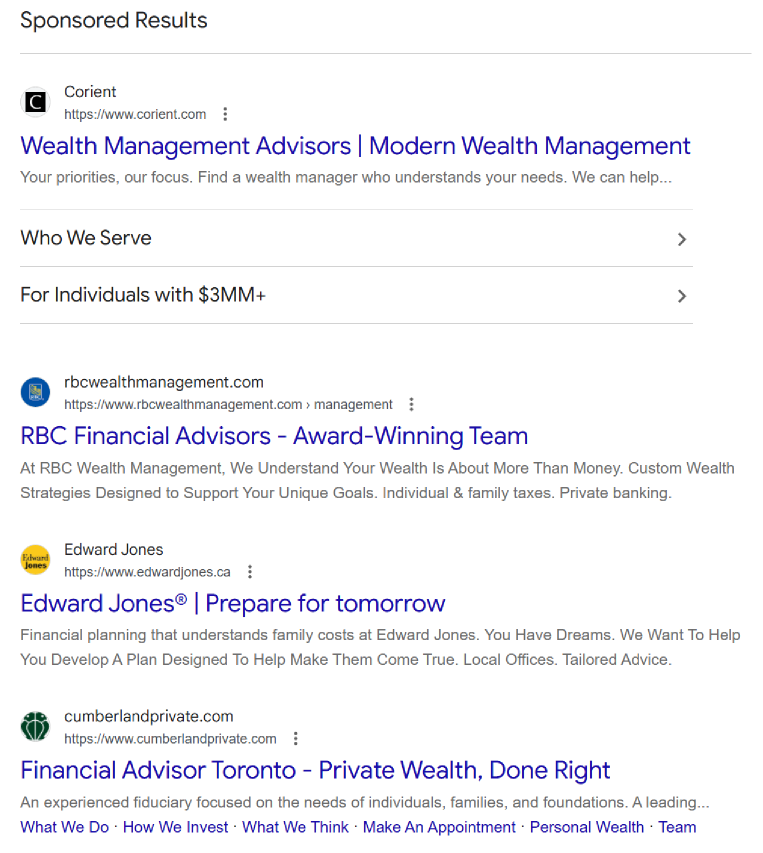
Nobody keeps paying for ads that do not bring clients. If these firms are in the auction for your city's searches and you are not, those clicks go to them by default.

So, do ads make sense for wealth management?
Ads will not close a $10 million relationship, but they influence your prospects before and when they are in market.
The answer is yes, with one caveat worth holding onto. Nobody hands over $10 million because they saw an ad, and an ad sold on that promise will disappoint. What it does instead is put your firm in front of the right person at a moment that matters, so that when they are ready to choose, you are already on the list.
What needs to be in place to run ads?

Are you ready?
Proof (clients, one clear offer, reviews).
A funnel (a landing page and a booking link that convert).
A CRM (every lead recorded, so you can follow up and pass closed clients back to Google).
Numbers (what a client is worth, what a lead can cost).
No social proof yet.
No page a lead can act on.
No one owns the follow-up.
No idea what a client is worth.
Ads send strangers to your website. Before that happens, four things need to exist: proof that other people trust you, a page where a stranger can take a next step, a system that records every lead so that someone follows up, and a number for what a client is worth so you know what a lead can cost. If the second column is a fair description of your firm today, that is the work to do first, and the ads will still be available once it is done.

How to pick a channel

Three things pick your channel
Where do they spend time? Does demand already exist, or must you create it? Search captures demand, social creates it.
Social runs on creative, refreshed constantly; search is mostly text.
Search clicks cost more, social is cheaper per click but colder per lead, LinkedIn costs the most.
Answer all three honestly and the channel picks itself.
Google, Meta, LinkedIn, YouTube and Reddit all sell ads, and which one fits depends on where your clients already spend time, what your team can actually produce, and what you can afford to spend. Two things are worth knowing before you choose. The first is that it pays to pick one channel and get good at it before adding a second. The second is that when a firm says a channel did not work for them, the problem is more often the execution than the channel.
What each platform asks of you
| PAID SEARCH (GOOGLE, BING) | PAID SOCIAL (META, YOUTUBE, TIKTOK, REDDIT) | |
|---|---|---|
| Demand | Captures what people already want | Creates want where there wasn't any |
| Feeds on | Text: keywords, ad copy, a matching landing page | Creative: video or images, refreshed often |
| Cost per click | Higher: high intent, high competition | Usually cheaper, lower intent |
| First leads | Days | Weeks of creative testing |
| Start here if | You have no creative team. Text is enough | You can produce and refresh creative |
The rest of this article is about Google.
Paid social depends on video and images good enough to stop someone scrolling past, and they have to be replaced before they go stale. Paid search needs good ad copy and a landing page that matches what the person searched for. Search clicks cost more, and the people clicking them are closer to a decision. If people are already searching for what you sell, search is where to start, which is why the rest of this article is about Google.
Google Ads 101

Know your numbers, then work backwards
What a client is worth over the whole relationship.
The most you can pay to win one client; that ceiling sets the budget.
How many leads it takes to sign one client.
Target cost per lead = CAC ÷ leads it takes to sign one client.
That is the number you hand the campaign. Everything else is a diagnostic. Optimise for the action closest to revenue: a booked consultation, not a newsletter signup.
A worked example. A client pays $10,000 a year in fees and stays ten years, so the relationship is worth $100,000. Decide what you would pay to win that client, say $10,000. If it takes ten leads to sign one client, a lead is worth $1,000 to you. That is the target you give the campaign. Without it you cannot brief an agency, and you cannot tell Google what to aim for.
Tracking, set up before you launch
Conversion tracking is how Google learns which of the clicks it sent you turned into a booked call, a form or a phone call. Without it, neither you nor Google can tell which part of the spend is doing the work. The technical setup is a longer conversation than this article allows, but the timing is the part to remember: it has to be working before the first ad runs, not after.
Garbage in, garbage out
The goal you give the platform is the thing it optimises for.
You get people who visit contact pages and leave. More volume, lower quality, fewer conversions.
You get more people who book. Fewer clicks, but better ones.
Ad platforms run on machine learning, so the goal you set is the thing they get better at producing. Ask for clicks or page visits and you will get plenty of both, from people who had no intention of booking anything. Ask for booked consultations and the platform starts looking for the people likely to book one. Choosing the wrong goal is the most common reason a firm concludes that ads did not work for them.
How much budget do you need to start?
The floor to run one market properly. Below that you're not testing, you're sampling.
Before you conclude it doesn't work. Google needs signal volume to learn who converts.
Beyond that, budget shouldn't be the limiter. If your unit economics hold, the only real limit is how many clients you have capacity to take on.
Google learns from volume, which is what both of these numbers are really about. Under $1,000 a month in a single city there is not enough data for it to learn anything useful, and under $5,000 in total there is not enough to judge whether the campaign works. Above that, the budget is set by your cost per lead against your ceiling, and by how many new clients your firm can take on. For context, the average cost per lead in finance and insurance search ads is about $74. LocaliQ, Search Advertising Benchmarks 2026
The three keyword match types
| TYPE AND SYNTAX | REAL SEARCHES IT TRIGGERS | USE IT |
|---|---|---|
| Exact: [financial advisor san diego] | san diego financial advisor · financial advisers san diego. Won't show for "financial advisor jobs san diego" | Start here |
| Phrase: "fee only financial planner" | fee only financial planner for retirees · best fee only financial planner near me | Add later |
| Broad: financial advisor | how do i choose a financial advisor · wealth management fees explained | Avoid |
Then read the search terms report every week and add negatives. In a small account, that habit is the optimization.
When you bid on a keyword, Google lets you choose how closely a search has to match it. Exact match shows your ad for that search and close variations of it. Phrase match adds searches that contain its meaning. Broad match can show your ad for anything Google considers related, which is how budgets get spent on searches that were never going to become clients. Google will recommend broad match to you, and it is the one to refuse. Start with exact, add phrase once exact is producing, and leave broad alone. Google Ads Help, keyword matching options
Bid on high-intent keywords
wealth management firm near me
financial advisor for business owners
fee only financial planner near me
what is wealth management
how much should I save for retirement
what does a financial advisor do
The first group comes from someone choosing a firm right now. The second comes from someone who is still learning, and more and more of those searches never reach a website at all, because Google's AI Overviews answer them on the results page. Paying for the second kind is paying for traffic that was never going to convert, and the same reasoning applies to the content you write for search.
Be local, not broad
"wealth management firm"
You're bidding against national firms with national budgets, for people who may be nowhere near you.
"wealth management firm north vancouver"
Fewer searches, far more of them real. Cheaper clicks, and a market a small firm can actually win.
A national keyword puts you in an auction with the largest firms in the country, for people you may never be able to serve. A local one has fewer searches, but more of them are real prospects, the clicks cost less, and the competition is one a small firm can win.
Match the intent across the funnel
The search, the keyword, the ad and the landing page all have to say the same thing. If someone searches for a retirement advisor in Toronto and arrives on a general homepage, they leave, because clicking back costs them nothing. Of everything in this article, this is the piece that most often decides whether a campaign converts.
Key factors that decide whether you win the auction
What share of those visitors book a call. Double it and your cost per lead halves, no extra budget, no higher bids.
Google's own score for how well that chain holds together. Strong relevance means you pay less per click than a competitor bidding the same amount.
The auction is not won by the highest bid. Google scores each ad on expected click-through rate, how well the ad matches the search, and how useful the landing page is, and a higher score means a better position at a lower price. A more relevant ad with a better page can outrank a competitor paying more per click. Google Ads Help, About Quality Score
Two things to know before you launch
Google requires financial services verification in some countries, and can ask any advertiser to verify who they are. Check what applies to you the day you open the account; it's a common reason a first campaign never runs.
The listings above the regular ads with a Google badge. You pay per lead, not per click. Financial planning is an eligible category in the US, not yet in Canada.
Two practical checks. Google runs a financial services verification programme in a list of countries, where advertisers prove they are authorised by a regulator before financial ads can run. As of September 2026 that list does not include Canada or the United States, but Google can still ask any advertiser to prove who they are, so check before launch. Local Services Ads are a separate product where you pay per lead instead of per click. Financial planning is eligible in the US and not yet in Canada. Both change, so check again before you budget for either. Google Ads Policy, financial services verification by country · Local Services Ads, US · Local Services Ads, Canada
The funnel behind the ad

What makes the funnel work
Crystal clear, gives more than it takes.
The ad, the page and the ask all say one thing.
A great online presence.
The ad's job ends at the click. From there, three things decide whether the visit becomes a lead. The offer has to be clear and give more than it asks for; a stranger will trade an email for something useful, not a phone call for nothing. The journey has to stay consistent from the search to the page to the follow-up. And the website has to keep making the case the ad started, because the ad has a few words and the page has room.
The ad brings the visit. What happens during and after the visit decides whether it converts.
A form, an email address, a phone number or a booking link can all turn a visit into a lead. Two things matter more than which one you use: how easy the next step is, and how convincing the page is. A page that is hard to use will still convert when the product is in very high demand, but most firms are not in that position and should not plan around it.
The ad, the page and the ask said the same thing
Some of the people who registered for this webinar came from an ad
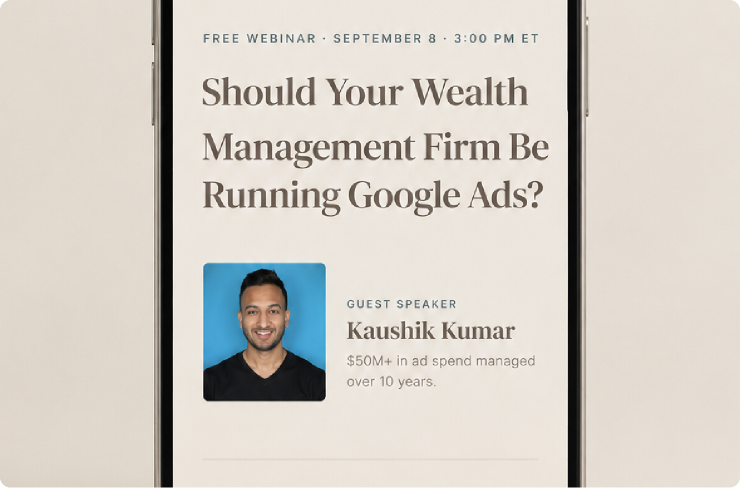
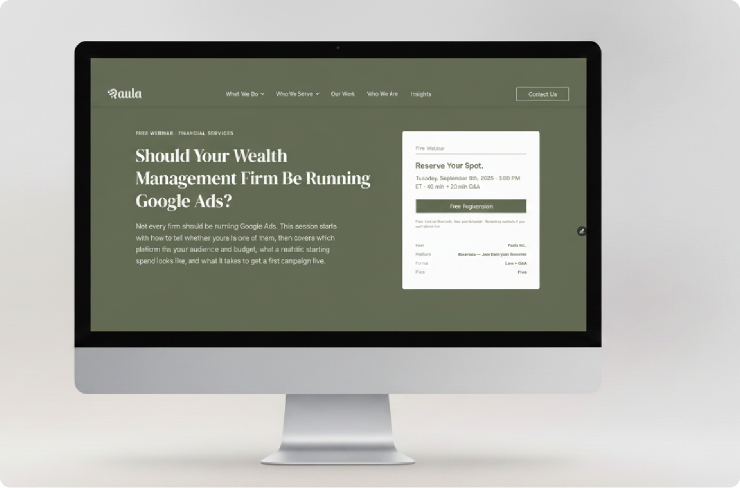
This webinar is its own example. Part of the audience registered through a LinkedIn ad. The ad spoke to wealth advisors and said what the session was. The landing page said the same thing. The ask was an email address, in exchange for a full session on getting started with ads. The message stayed the same from the ad to the page to the ask, and the trade favoured the visitor. That is why it worked. It is not a sale, but the firms that registered now know who to call when they need help.
Do not let your maybes fall through the cracks
A decision about choosing a wealth manager can easily take a year or longer. Your funnel should be able to handle that.
A webinar on something they are dealing with now; research they can't get from ChatGPT; an event where they meet people like them.
Useful now, made for people like them, nothing for sale.
Knows who is who and what they care about; makes the right people easy to find when a touchpoint comes along; makes it easy to reach them, and to track who was contacted about what.
Most people who become a lead are not ready to buy. In wealth management the decision can take three months or three years. Many firms are built for one call and one answer, and everyone who says "not yet" is lost. Keeping those people warm takes two things: content that is useful to them now with nothing for sale, and a system that remembers who they are and makes them easy to reach when the next touchpoint comes along. This is where most of the value of a campaign is won or lost, and it is the part of the funnel that Paula builds.
Your first 30 days

Five steps to your first lead from Google
| WEEK | STEP | WHAT IT MEANS |
|---|---|---|
| 1 | Set your goals | Client value, lead value, target cost per lead, and the CAC ceiling you won't cross |
| 1 to 2 | Build the plumbing | Conversion tracking and call tracking live, verification started, one landing page with one call to action |
| 2 | Launch one campaign | Your money keywords only, exact and phrase, one city, a budget you can hold for a month |
| 3 | Clean it weekly | Search terms report reviewed, negatives added, weak ad copy replaced, landing page tightened to match |
| 4 | Read the numbers, then decide | Cost per lead against your ceiling, and lead quality against your pipeline. Scale, fix, or stop |
Three details worth adding to the table. Plumbing sometimes includes getting more reviews, because people look a firm up before they convert. The landing page gets one call to action, not several. And a campaign is not a tap you turn on: running it for a week, seeing nothing and stopping is the usual way firms decide that ads do not work.
Questions from the audience
When do you know a campaign is not working and should be stopped?
Two conditions have to be met before stopping is the right call. The first is that you have spent enough for the result to mean anything, which is the $1,000 a month and $5,000 in total described earlier, and that you have given it two or three weeks rather than a few days. The second is that the cost of each lead, once those leads are in, is still higher than the business can carry.
Even then, it is worth finding out which part is failing before switching anything off. A campaign has four places where it can break: the keyword you bid on, the ad itself, the landing page, and the follow-up after someone enquires. A high cost per lead can come from any of the four, and only one of them is solved by stopping the campaign.
How do you know when you have maxed out your spend?
There are two signals, and they tell you different things.
The first is a Google metric called search impression share. It tells you what share of the searches you were eligible for actually showed your ad, and it splits the share you lost into two causes: budget and rank. If you are losing impressions because of budget, you have not maxed out, and there is demand sitting there that you are not paying to reach.
The second is whether more money still brings more clients. If you raise the spend from $10,000 a month to $30,000 and the number of new clients does not move with it, the extra spend is not buying anything, and that is the point to stop increasing it.
Should a newer firm start with AEO and SEO, or with ads?
Both, if the firm can produce the content that the organic side needs. The order that usually works is to start the ads while the organic work is being built, because ads produce something within weeks and an organic presence takes months.
The two also depend on each other more than they look. The ad buys the first look. What happens next is that the person looks your firm up, increasingly by asking an AI assistant rather than by searching, and what they find is your website and whatever else has been written about you. If that material does not make a good case for your firm, the assistant will not make one either, and the click you paid for is wasted.
Where to go from here

Kaushik helps companies build predictable pipeline and revenue through demand generation, paid media, and growth strategy. Over more than 10 years he has managed $50M+ in ad spend, helping scale companies from under $10M to $50M+ ARR, working with brands like Uber, MasterClass, and Workleap. LinkedIn
Questions about running ads? Use the form below.

A decade inside financial services before starting Paula in 2023. LinkedIn
Questions about the funnel behind the ad? Use the form below.
Looking to run ads or set up your sales funnel?
Let's connect and see how we can help.