.svg "Paula")

Recently, I've been doing some work around how Wealth Management firms can position themselves for success on LLMs and noticing, among other takeaways, that people are definitely going online to find help.
In Canada, nearly 10,000 people are searching for "financial advisor" every single month. Another 390 are specifically asking Google "how to choose a financial advisor."
If you lead strategy for an investment firm (or even if you are a curious PM, IA, or FA), here is a quick look at the data and what it means—especially as search behavior evolves with AI.
Broad terms don't work
Terms like "wealth management" and "financial advisor" get massive volume, but the keyword difficulty (KD%) is deep red. Trying to rank here means fighting major banks for visibility. Even if you win, you’re mostly capturing unqualified retail inquiries, rather than your target clients.
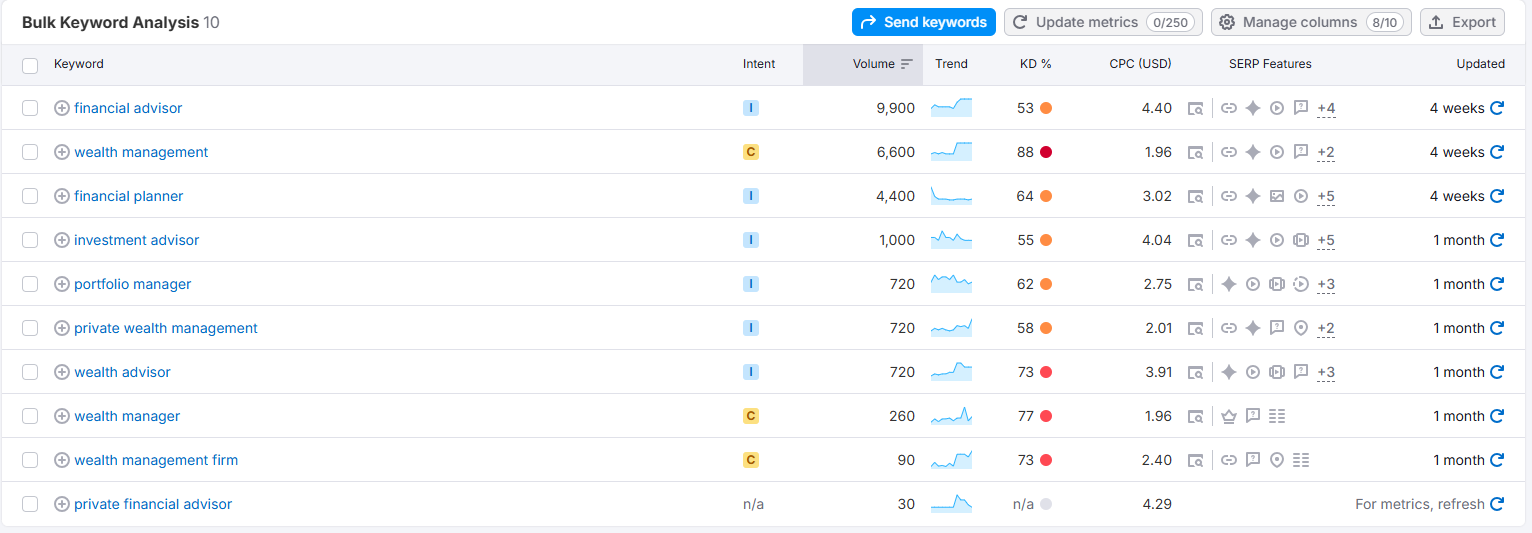
(A quick guide to reading the data above:)
-
Volume: The estimated number of times people search for this exact phrase on Google every month.
-
KD % (Keyword Difficulty): A score from 0 to 100 showing how hard it is to rank on the first page organically (by publishing content that targets that keyword). Red means highly competitive.
-
CPC (USD): Cost Per Click. The estimated spend of advertisers who pay Google to show up at the top when people search this keyword.
Firms are bidding on the wrong terms
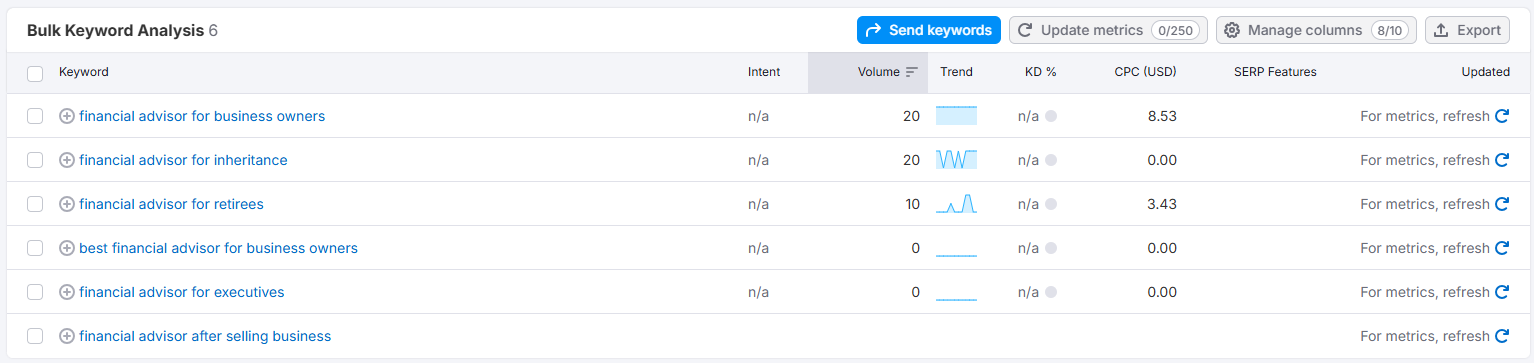
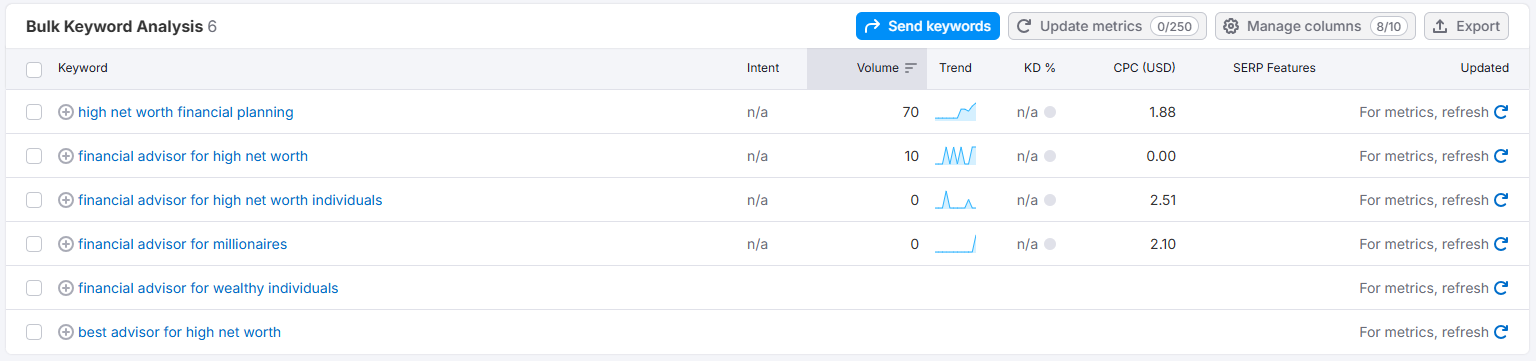
Firms are paying top dollar (sometimes $8.50+ per click) for phrases like "financial advisor for business owners," but the organic search volume is practically zero. This might be because high-net-worth clients don't search this way. Instead, they search for solutions to complex problems (e.g., "tax implications of selling a private corporation").
Specific titles attract better prospects
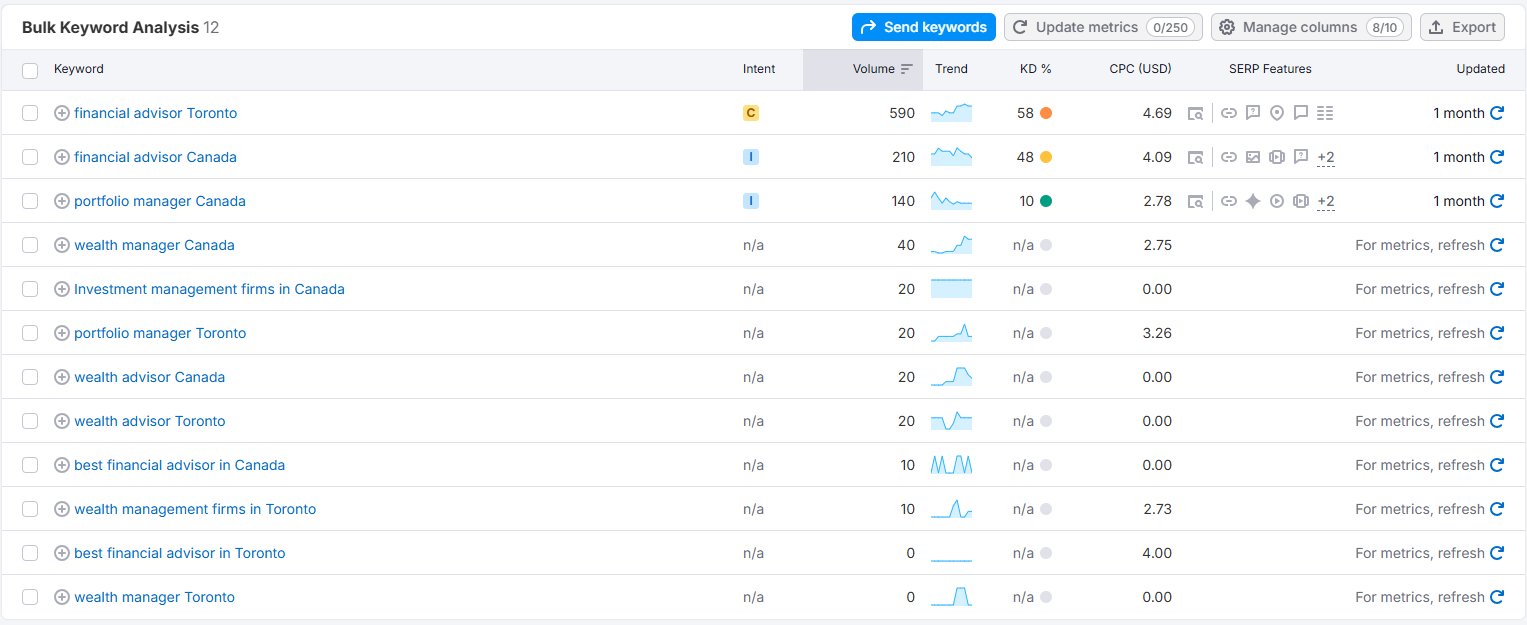
"Portfolio manager Canada" only gets 140 searches, but the difficulty drops to a green 10. Because it’s a specific designation, people searching for it usually understand the industry and want discretionary management. Optimizing for this title filters for higher intent with a fraction of the competition.
Leveraging this for your content strategy
Here are three practical ways to use this data, especially as SEO evolves into AEO (Answer Engine Optimization)
1. Target your client's problems, not their labels Broad industry terms ("wealth management") are heavily saturated by major banks, and prospects rarely search using demographic labels ("advisor for business owners"). Instead of optimizing your site for who you want to reach, optimize for the specific, complex questions they are trying to solve (e.g., "tax implications of selling a private corporation in Canada"). This naturally bypasses the big banks and attracts high-intent traffic. This is becoming increasingly important as people switch their searches to LLMs.
2. Lean into your specific fiduciary designations While general terms like "financial advisor" are a trap, specific regulated titles are a hidden advantage. Optimizing for terms like "Portfolio Manager" allows you to capture a sophisticated audience that actively understands the difference between retail advice and discretionary management, all with a fraction of the SEO competition.
3. Treat traditional SEO as the foundation for AI search You should definitely want your firm to show up when prospects ask LLMs for financial guidance. However, AI engines don't just invent answers; they synthesize them by pulling from authoritative pages that already rank well in traditional search. By using keyword data to rank for specific, complex questions on Google, you are simultaneously building the exact source material that AI engines look for and cite. Traditional SEO is still a major component of a modern AI search strategy.